Espresso Shot Time: What It Tells You and What It Doesn't
The clock is a clue about flow. It is not a grade, and it is not the recipe.
Every espresso guide gives you a number of seconds, and every new espresso owner ends up staring at a timer like it owes them money. The shot ran 22 seconds. Is that bad? It ran 31. Is that worse? The honest answer is that the clock is telling you something real, just not the thing most people think it is telling them.
Shot time is a measurement of flow. It says how long it took a certain amount of water to push a certain weight of coffee out of the basket. That is genuinely useful when you are dialing in. It is not a score, and a shot does not become good by arriving on time.
The short answer
Shot time tells you how fast water moved through the puck, which is mostly a clue about grind size. It does not tell you whether the shot tastes good. Start with a fixed dose and a 1:2 ratio, aim for roughly 25 to 30 seconds, and treat that window as a place to begin rather than a pass mark. Stop the shot on weight, read the time afterward, and let your tongue have the last word.
If a shot tastes good at 34 seconds, it is good. If it hits 28 seconds exactly and tastes sour, the clock was right and the shot was still sour.
What you need
- A fixed dose. Whatever your basket is built for, usually somewhere around 18 grams for a double. Same dose every time while you are reading the clock.
- A way to weigh the yield. Any scale that reads to 0.1 grams and fits on the drip tray. See Scales for Coffee if you don’t have one.
- A timer. Your phone works. So does a scale with a timer built in.
- One bag of beans. Switching bags in the middle of a session changes everything at once, which is the opposite of what we’re doing here.
- A notebook, or a note on your phone. Dose, yield, time, taste, next move. One line per shot.
What shot time actually measures
Espresso has three numbers you can easily write down: the dose (grams of dry coffee in), the yield (grams of liquid out) and the time between them. Dose and yield are the recipe. Time is the result of how hard the puck resisted the water.
The puck resists more when the grind is finer, and less when it is coarser. That is why time is such a handy clue: if your dose and yield are fixed and the shot suddenly runs fast, the grind is the first suspect. A study of espresso in coffee shops found that grinding accounted for 87 to 96 percent of the variance in their data, and the authors concluded that grinding had the most important effect on quality [3]. The clock is how you see that effect without a lab.
The trouble is that grind isn’t the only thing that moves the clock. The Specialty Coffee Association’s 2026 research feature on the Hendon Coffee Lab lists grind size, brew time, water temperature, pressure, coffee mass, basket shape and water volume as factors in what ends up in the cup, and it makes a point I wish more forum threads would absorb: the variables push on each other [1]. Hotter water changes how fast it flows through the puck, which changes the brew time, which changes the chemistry. Change one thing and two others quietly move with it.
That lab work is ongoing. The feature describes how the team plans and randomizes experiments and is building up measurements; it does not hand down a finished home recipe or a magic number of seconds [1]. I’d take that as the honest state of things. Nobody has a single correct shot time for your beans, because there isn’t one.
Why yield matters more than seconds
Here’s the part that surprised me when I went looking. A 2023 laboratory study varied grind, flow rate and water temperature and tracked several compounds as the shot came out. Flow rate had the strongest effect of the three on how much ended up in the cup, and that effect was bigger at finer grinds and hotter water. But the authors also found that all of those influences were minor compared with changes in the total amount of espresso extracted [2]. In plain words: how much liquid you let into the cup moved the result more than the conditions it flowed under.
That lines up with what a logbook shows. If you stop the shot by the clock, at 28 seconds, a fast-flowing shot gives you a big, thin drink and a slow one gives you a small, heavy one. You have changed the yield without meaning to, and the yield was the bigger lever. If you stop the shot by weight, at 36 grams, the yield stays fixed and the time is free to tell you about the grind. That is the whole trick.
Stop on weight. Read the clock afterward.
One variable at a time
One variable: grind size. Dose, yield, beans, water and basket stay put.
With dose and yield locked, the clock becomes a clean signal. A shot that runs much faster than your last one means the puck offered less resistance, and the usual fix is a slightly finer grind. A shot that runs much slower means more resistance, and the usual fix is slightly coarser. You are not trying to hit a number for its own sake. You are using the number to see which direction the grind moved, then tasting to see whether you liked it.
Sour, thin, sharp shots usually point toward under-extraction, and grinding finer, which also slows the shot, is the first thing to try. Bitter, dry, harsh shots usually point the other way. Our guides on why espresso tastes sour and shots that run too fast go further into each.
There is one trap with going finer. Research modeling espresso found that extraction peaked at a middle grind and dropped again at very fine settings, which the authors put down to water forcing uneven paths through a tightly packed puck [4]. That uneven flow, called channeling, also made shots less repeatable. So if you keep grinding finer, the shot gets slower and slower, and the taste gets worse rather than better, you have probably passed the useful range. Go back a step.
Reading the clock, step by step
- Choose when the clock starts, and never change it. Most people start when they press the button, which includes any preinfusion. Some start at first drops. Either is fine. Mixing them is how two identical shots end up four seconds apart in your notes.
- Tare the cup on the scale. Put it on the drip tray, zero it, and lock in the portafilter.
- Start the shot and the timer together. A timer scale with an auto-start mode can do this for you when it senses weight. A phone needs a free hand.
- Stop on your target yield. For an 18 gram dose at 1:2, that’s 36 grams. Stop a gram or two early if your machine keeps dripping after you switch it off; you’ll learn how much it adds.
- Write down the time. This is the number you read, not the one you chase.
- Taste before you decide. Sip it straight, even if you’ll make a latte with the next one. Sour, bitter, thin, heavy, sweet or flat.
- Make one change. Usually a step finer or coarser on the grinder. Then pull again.
A shot log
This shot log is fictional and illustrative. It shows how the clock helps you find the direction, and how taste decides when to stop.
| Dose | Yield | Time | Taste | Next move |
|---|---|---|---|---|
| 18 g | 36 g | 19 s | Sour, thin, a bit salty | Two steps finer |
| 18 g | 36 g | 26 s | Sweeter, still a little sharp | One step finer |
| 18 g | 36 g | 31 s | Sweet, heavy, no sharpness | Keep it |
Notice that the “keeper” ran 31 seconds, just outside the textbook window. Nothing went wrong. The dose and yield never moved, the clock showed the grind was heading the right way, and the third cup tasted best. That is what the window is for. It got me close; my tongue did the rest. If the 26 second shot had tasted best, I’d have kept that one instead.
What the clock can’t tell you
Time is a useful number with some big blind spots. It can’t tell you:
Which way your last grind change moved
Whether the shot tastes good
Faster than last time: try finer
Whether the water ran evenly or channeled
Slower than last time: try coarser
Your yield, if you stopped by the clock
Roughly 25 to 30 s is close at 1:2
What a forum post's 27 s means on your machine
Your routine is repeating
Whether the beans are stale
- Whether the shot tastes good. Two shots can share a time and taste completely different, especially across different beans or roast levels.
- Whether the flow was even. A puck can channel, sending water down a few fast paths, and still finish in a respectable time because the rest of it was choking. Time measures the whole shot, not how evenly it ran.
- What your yield was, if you stopped by the clock. This is the most common mix-up. Stop on weight, or the time is measuring two things at once.
- Anything about another person’s setup. Different baskets, machines and preinfusion settings shift the clock. A forum post’s 27 seconds is not a target for your machine.
- Whether the beans are the problem. Stale or undated beans can pour at a perfectly ordinary time and still taste flat. The clock looks fine. The cup is not.
What it can tell you, reliably, is whether your last change moved the grind in the direction you meant. That is plenty. It’s also why the time on its own deserves less attention than it gets.
The tools that make timing easy
You do not need to buy anything to read shot time. A phone timer and a basic 0.1 gram scale will do it. A coffee scale with a built-in timer puts the weight and the seconds on one display, so you can stop on yield and note the time without juggling two screens. That’s the entire case for one. Below are three I’d look at, at three prices. My view is based on the manufacturers’ published specs and product pages, not on hands-on testing. Prices are from the brands’ own stores when we checked and change often. These are plain links, not affiliate links.
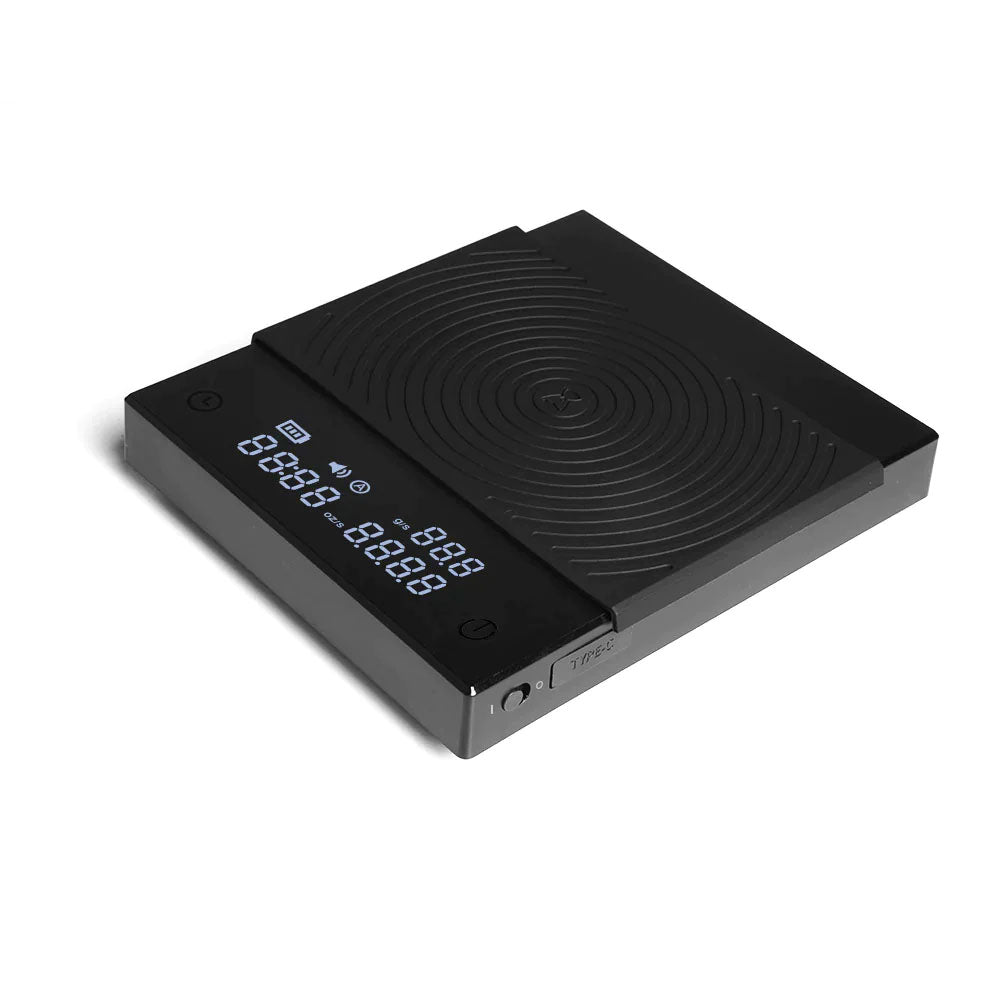
TIMEMORE Basic 2.0 Electronic Espresso Scale with Timer. Photo: TIMEMORE
TIMEMORE Basic 2.0 (about $55 to $60). Reads in 0.1 gram steps up to 2 kilograms, with an automatic timer and a flow-rate display, a rechargeable battery and a waterproof surface, according to TIMEMORE. Who it’s for: most people starting out who want weight and time on one screen without spending much. Who should skip it: anyone with a very tight drip tray, who should measure first; and anyone happy with the phone-plus-scale routine they already have.
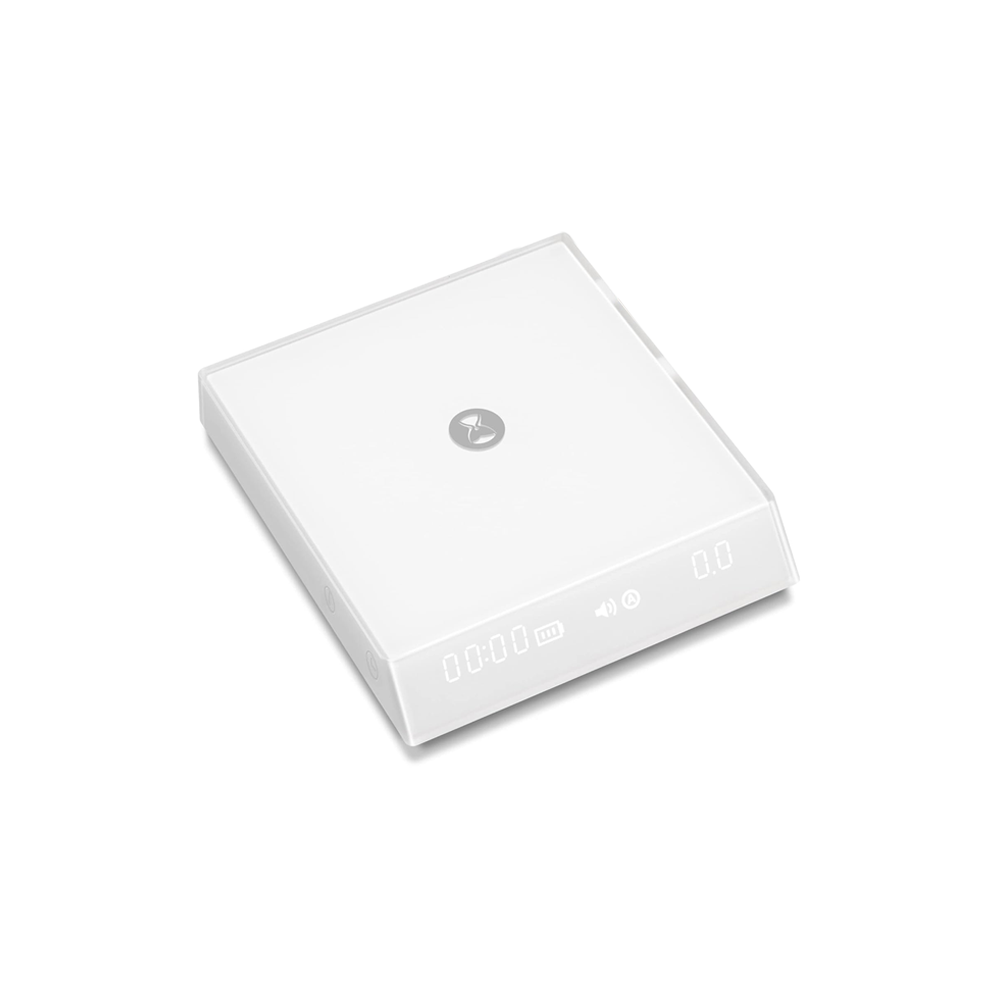
TIMEMORE Black Mirror Nano Coffee Scale with Timer. Photo: TIMEMORE
TIMEMORE Black Mirror Nano (about $100). Smaller, at a listed 3.9 by 4.5 by 0.8 inches, built to fit on the drip tray of a compact home machine. It reads 0.1 grams to 2,000 grams, and its auto mode starts the timer when it senses a change in weight, which handles step three for you. Who it’s for: owners of compact machines where a bigger scale won’t fit under the cup. Who should skip it: anyone whose current scale already fits, because size is most of what the extra money buys.
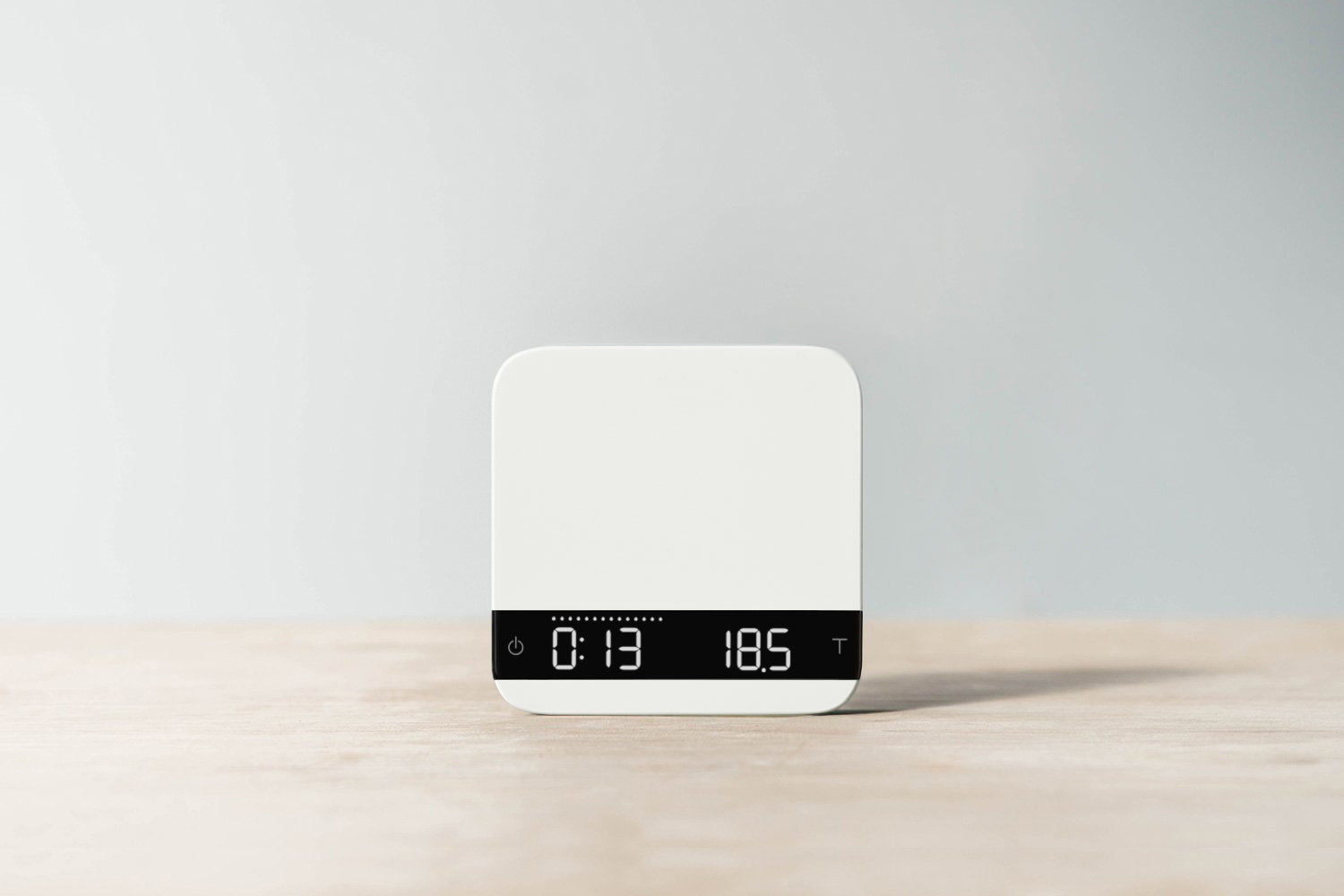
Acaia Lunar. Photo: Acaia
Acaia Lunar (about $250). An espresso-specific scale in water-resistant anodized aluminum, with automated brewing modes, a flow-rate indicator and a two-year warranty that Acaia says covers water damage. It ships with a heat-resistant pad and a 100 gram calibration weight. Who it’s for: people who pull several shots a day and want something built to survive drips and steam for years. Who should skip it: almost everyone else. It reads time and weight. So does the $55 one.
None of these will improve a shot. They make it easier to repeat one, and repeatable is what lets you learn from the clock. If the choice is between a $250 scale and a better grinder, the grinder wins, and it isn’t close.
Common mistakes
- Stopping on time instead of weight. The single most common one. It quietly changes the yield, which the research suggests matters more than the seconds [2].
- Chasing a number past good taste. If the shot tastes good at 23 seconds, you are done. Nobody is grading the timer.
- Changing the start point. Button press one day, first drops the next. Pick one.
- Changing two things at once. New beans and a finer grind on the same morning means you’ll never know which did what.
- Copying someone else’s time. Their basket, machine and preinfusion are not yours.
- Grinding finer forever. Past a point, finer means uneven flow and worse shots, not better ones [4]. If it gets slower and tastes worse, go back.
- Blaming the clock for the beans. A perfectly timed shot from stale beans is still flat. Check the roast date before the timer.
The upgrade ladder
- Fresh, dated beans. Free improvement compared with the stale bag you’re fighting.
- A phone timer and any 0.1 gram scale. Enough to read shot time properly.
- A grinder that can make small, repeatable changes. This is what the clock is actually reporting on, so it’s where the money goes.
- A timer scale. Convenience, not capability. Buy it when juggling two screens is the thing annoying you most.
For the full routine, start with How to Dial In a New Bag of Coffee. Use the clock to find the direction. Use your tongue to decide when you’ve arrived.
Caffeine, heat and your machine. The FDA says up to about 400 mg of caffeine a day is not generally associated with negative effects for most healthy adults; pregnancy, some heart conditions, anxiety, reflux and certain medicines can change that, so check with a clinician if any apply [5]. Steam wands and group heads are hot enough to burn. Unplug and cool a machine before opening or cleaning it, and follow the manufacturer’s descaling instructions.
Related reading: Why Is My Espresso Sour? | Scales for Coffee
Frequently asked questions
What is the right espresso shot time?
There isn't a single right time. About 25 to 30 seconds for a 1:2 ratio is a sensible starting window for a double shot, and many good shots land outside it. Use the window to get close, then let taste decide whether to grind finer or coarser.
When should I start the timer?
Pick one moment and always use it. Most people start when they press the button, not when the first drops appear, because that includes any preinfusion and is easier to repeat. What matters is that today's 28 seconds means the same thing as yesterday's.
My shot hits 28 seconds but tastes sour. What now?
Trust the taste over the clock. First check that you hit your target yield, because stopping on time instead of on weight is the most common mix-up. If the yield is right and it is still sour, try a slightly finer grind or a slightly longer yield and taste again.
Do I need a scale with a timer?
No. A phone timer and any scale that reads to 0.1 grams will do the job. A timer scale puts weight and time on one display, which makes it easier to stop on yield and note the time in the same glance. That is a convenience, not a requirement.
Sources and further reading
- Specialty Coffee Association, Dialing In, Decoded: How Electrochemistry Helps Us Understand Espresso Extraction (25 Magazine, Issue 25)
SCA feature published April 29, 2026, on the Hendon Coffee Lab at the University of Oregon. Lists grind size, brew time, water temperature, pressure, coffee mass, basket shape and water volume as factors in espresso composition, explains that changing one (such as water temperature) shifts others (flow speed and brew time), and describes the lab's ongoing design-of-experiments and electrochemistry work. It reports no finished shot-time recommendations.
- Schmieder, Pannusch, Vannieuwenhuyse, Briesen and Minceva, Influence of Flow Rate, Particle Size, and Temperature on Espresso Extraction Kinetics
Foods 2023;12(15):2871, doi:10.3390/foods12152871. Laboratory study using a central composite design; flow rate had the strongest effect on component mass in the cup, more so at finer grinds and higher temperatures, but these influences were minor compared with differences in total extracted espresso mass (the yield).
- Severini, Derossi, Fiore, De Pilli, Alessandrino and Del Mastro, How the variance of some extraction variables may affect the quality of espresso coffees served in coffee shops
Journal of the Science of Food and Agriculture 2016, doi:10.1002/jsfa.7472. Grinding grade accounted for 87-96% of the variance in the experimental data; the authors concluded that grinding had the most important effect on espresso quality.
- Cameron, Morisco, Hofstetter, Uman, Wilkinson, Kennedy, Fontenot, Lee, Hendon and Foster, Systematically Improving Espresso: Insights from Mathematical Modeling and Experiment
Matter 2020;2(3):631-648. Extraction yield peaked at a middle grind setting and fell at very fine settings, which the authors attribute to uneven flow through the puck that also makes shots less reproducible.
- FDA, Spilling the Beans: How Much Caffeine is Too Much?
FDA consumer guidance: up to about 400 mg of caffeine a day is not generally associated with negative effects for most healthy adults.
Sources checked October 24, 2026. This is an editorial summary, not a systematic review or individual advice.